

Home insurance complaints are on the rise again. The Australian Financial Complaints Authority (AFCA) has released its Annual Review for 2025-26, and after two years of decline, complaints about home building insurance jumped 25%. Delays in claim handling were once again the single most common reason Australians complained about their insurer. For Queensland homeowners, landlords and strata committees heading into storm season, there are some clear lessons about what happens between the moment damage occurs and the moment a claim is settled.
Home insurance complaints are rising again
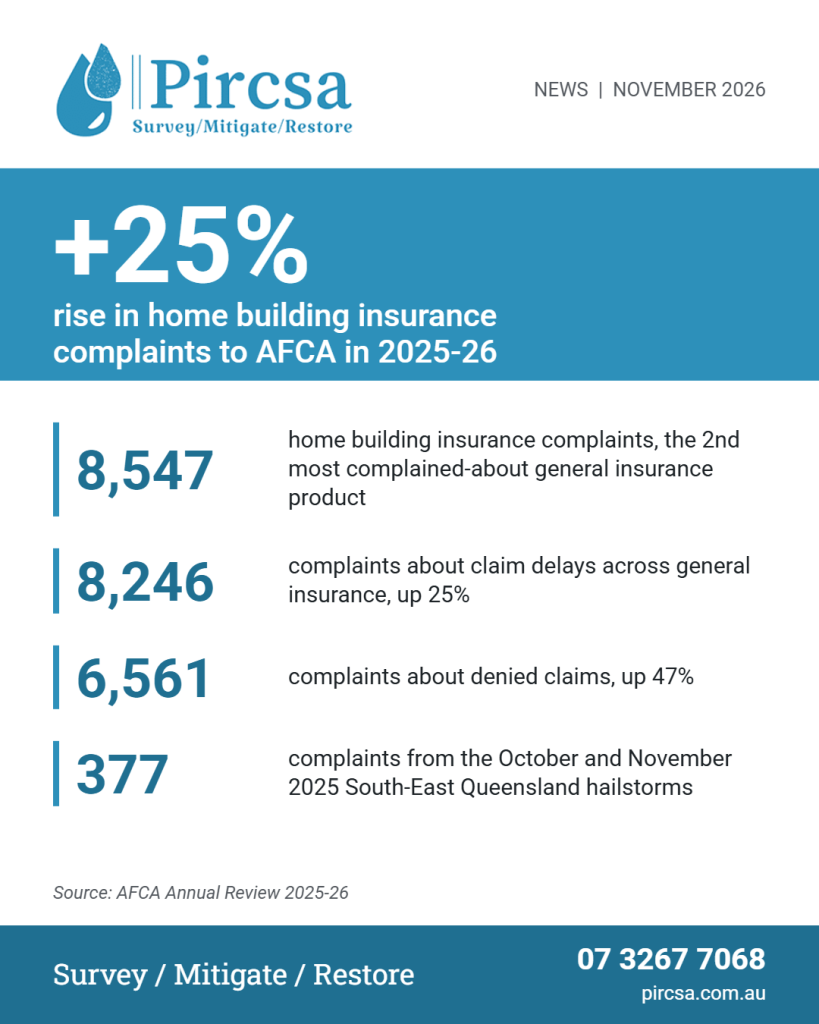
AFCA received 8,547 complaints about home building insurance between 1 July 2025 and 30 June 2026, up from 6,856 the year before. That makes home building the second most complained-about general insurance product in Australia, behind only comprehensive car insurance, and the fourth most complained-about financial product of any kind. Home contents complaints held steady at 1,756.
Across all general insurance, complaints reached a record 36,022, up 5%. The issues behind them tell the real story:
- Delays in claim handling: 8,246 complaints, up 25% and the most common issue
- Denial of claim: 6,561 complaints, up 47%
- Disputes over the claim amount: 6,376 complaints, up 20%
- Claims denied because of an exclusion or policy condition: 3,384 complaints, up from 2,503
South-East Queensland hail topped the list of major events
The Insurance Council of Australia declared seven significant events during the year. The October and November 2025 South-East Queensland hailstorms generated more AFCA complaints than any other, with 377 complaints across the two events. Delay in claim handling was the leading issue for both.
AFCA notes that complaints usually arrive several months after an event, once people have been waiting on repairs or decisions for a while. So while the overall numbers were lower than after some previous catastrophes, many South-East Queensland households are likely still working through hail-damaged roofs, ceilings and water ingress claims.
Why home insurance claims are taking longer
AFCA points to shortages of skilled trades and repair capacity, supply chain constraints and rising repair and replacement costs as the main reasons home claims took longer to resolve. It also expects insurers to keep closer oversight of their repair networks and to give customers timely, meaningful updates throughout the claim.
From the restoration side, the risk is simple: a building doesn’t wait for the paperwork. Water that sits in wall cavities, subfloors, insulation and joinery keeps doing damage every day it’s left. Within 24 to 48 hours mould can begin to grow, timber and particleboard start to swell, and a contained water damage event can turn into a much larger and more expensive repair. That, in turn, makes the claim harder for everyone.
What homeowners can do to protect their property and their claim
- Act early. Make the property safe, stop the water source if you can, and get a qualified restorer in to start mitigation. Most policies expect you to take reasonable steps to prevent further damage.
- Document everything. Photograph and video the damage before anything is moved or thrown out, and keep receipts, reports and correspondence.
- Get moisture measured, not guessed. Calibrated moisture measurement and documented readings show exactly what is wet, what is dry, and when the structure has genuinely returned to normal. That evidence supports a fair claim assessment.
- Dry the structure properly. Surface-dry isn’t the same as verified dry. Professional structural drying reduces the chance of hidden mould and secondary damage that can lead to disputes later.
- Ask for updates in writing. If your claim is delayed, ask your insurer to explain why and what happens next. AFCA expects insurers to communicate clearly during delays.
- Know where to go if you’re not happy. Complain to your insurer first through its internal dispute resolution process. If that doesn’t resolve it, you can lodge a free complaint with AFCA.
Our storm season checklist for Queensland properties covers the simple checks worth doing before the next storm arrives.
For insurers, loss adjusters and property managers
AFCA has made it clear that it expects insurers to focus on the recurring causes of complaints: claims delays, poor communication, inadequate explanations of decisions and inconsistent support for customers experiencing vulnerability. The restoration contractor is often the insured’s main point of contact on site, so the quality of that response matters.
Pircsa works to a survey, mitigate, restore process: fast mobilisation, documented moisture mapping, clear scopes and regular reporting at each stage, so adjusters, property managers and policyholders all know where a job stands. Learn more about who we work with and our restoration project management service.
Common questions
Should I wait for my insurer to approve the claim before starting drying?
Let your insurer know about the damage as soon as possible, but don’t let the property deteriorate while you wait. Emergency make-safe and mitigation work to stop further damage is generally expected under most policies. Keep records of everything done and check your policy wording or ask your insurer if you’re unsure.
Can AFCA help if my insurance premium has gone up?
Generally not. AFCA can’t consider complaints that relate only to the size of a premium, as insurers are entitled to set prices. It can consider complaints about whether a premium was properly disclosed, calculated or applied.
How long does it take AFCA to close a general insurance complaint?
In 2025-26 the average was 84 days, down from 96 days the year before. Around 54% of general insurance complaints were closed within 60 days.
Talk to Pircsa

Pircsa is an IICRC-accredited firm, and our technicians are IICRC trained. We help homeowners, property managers, strata committees, loss adjusters and insurers across South East Queensland with water damage, fire and smoke damage and mould remediation. Our fire and smoke assessments are led by Steve Cranston, an ACAC Council-certified Fire and Smoke Damage Consultant (CFSC).
Call 07 3267 7068, email office@pircsa.com.au or contact us online.
Sources
- Australian Financial Complaints Authority, Annual Review 2025-26, covering complaints received 1 July 2025 to 30 June 2026 (afca.org.au)