

Queensland’s 2025–26 storm season was no quiet one. According to the Bureau of Meteorology’s cyclone outlook, eleven tropical cyclones formed across the Australian region between November and April, seven of them reaching severe Category 3 or higher — well above the long-term average. Cyclone Narelle even made landfall across three states, including Queensland. Early climate outlooks suggest 2026–27 could shift toward El Niño conditions, which typically means fewer cyclones for the east coast — but it does not mean fewer severe thunderstorms, hailstorms or flash-flooding events. For property owners across Brisbane and South East Queensland, “quieter” cyclone conditions are not a reason to skip storm preparation. They’re a reason to prepare smarter — and exactly why we’ve put together the storm season checklist below.
Every year, PIRCSA responds to properties where a few hours of heavy rain turned into weeks of structural drying, mould remediation and insurance claims. In almost every case, some of that damage could have been reduced — or avoided altogether — with basic preparation before the first storm cell rolled in.
Why Prevention Beats Reaction
Water damage is rarely just about the water. Once moisture gets behind walls, under flooring or into ceiling cavities, the real risk begins in the 24 to 48 hours that follow, as trapped moisture creates the conditions mould needs to establish itself. That’s why our approach to water damage restoration always starts with a proper survey and moisture measurement rather than guesswork — and why prevention work done now is so much cheaper than mould remediation done later.
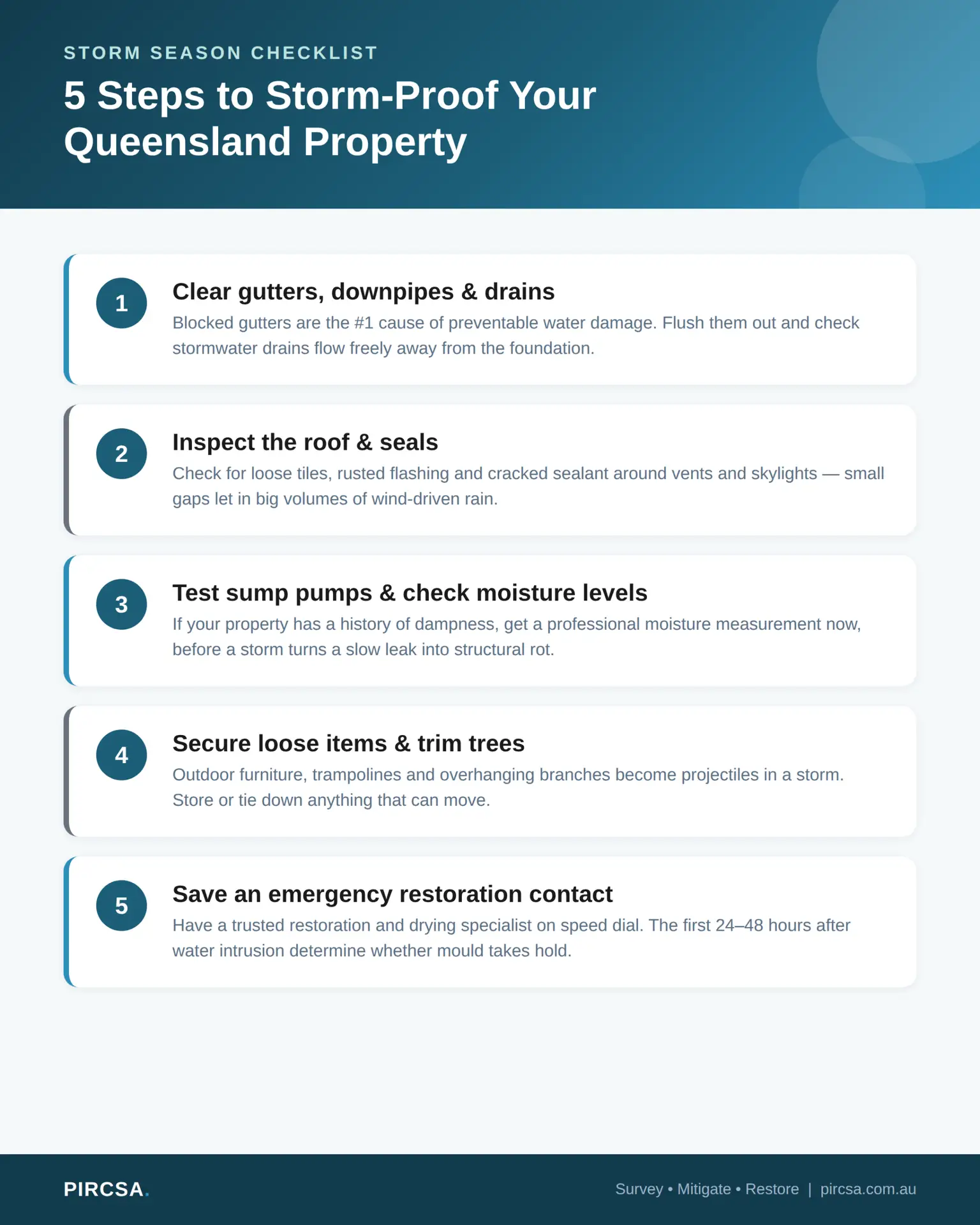
The 5-Step Storm Season Checklist
Before the wet season builds, walk your property with these five checks in mind:
- Clear gutters, downpipes and drains. Blocked gutters are the single most common cause of preventable water damage. Flush them out and confirm stormwater drains carry water away from your foundations, not toward them.
- Inspect the roof and seals. Loose tiles, rusted flashing and cracked sealant around vents or skylights look minor until wind-driven rain finds them. A small gap can let in a surprising volume of water during a single storm.
- Check moisture levels in problem areas. If a section of your property has a history of dampness, a professional moisture measurement now can flag a slow, hidden leak before a storm turns it into structural rot.
- Secure loose items and trim overhanging branches. Outdoor furniture, trampolines and dead branches become projectiles in high wind, risking both roof damage and safety.
- Save a restoration contact before you need one. Choosing a provider in the middle of an emergency rarely gets you the best outcome. Have a trusted, IICRC Regstered RIA and SCA QLD-affiliated restoration team on file in advance.
We’ve put these five steps into a simple storm season checklist you’re welcome to save or share with your property manager, strata committee or facilities team.
When Prevention Isn’t Enough
Even the best-prepared property can still take on water in a severe event. When that happens, the sequence of the response matters as much as the speed of it. Rushing straight to drying equipment without first measuring how far moisture has actually travelled through a structure is how avoidable mould remediation and repeat callouts happen. Our process is built around survey, mitigate, restore — in that order — using calibrated moisture measurement to guide structural drying so that walls, subfloors and ceiling cavities are verified dry, not just surface-dry.
Fire and smoke damage events follow a similar pattern. Water used to extinguish a fire, combined with humidity, can create secondary water and mould damage on top of the original loss if it isn’t managed correctly from day one.
Choose a Partner Who Manages the Whole Recovery
Queensland has no shortage of restoration companies promising a fast 24/7 response, and speed genuinely matters in the first hours after a loss. What often gets less attention is what happens after the drying equipment arrives — who is coordinating trades, verifying the work meets Australian standards, and managing the claim so nothing gets missed. With 48 years in property damage restoration, and membership with the Restoration Industry Association and SCA QLD, PIRCSA’s restoration project management service exists precisely for that gap — acting as a single point of accountability from initial survey through to final restoration.
Don’t Forget the Paperwork
A storm season checklist isn’t complete without your insurance paperwork in order. Before the wet season builds, take ten minutes to review your policy’s flood, storm and accidental damage cover, and confirm whether your sum insured still reflects the current cost of rebuilding — many Queensland policies haven’t been updated since well before recent construction cost increases. It’s also worth photographing or filming each room, your roof line and any recent renovations, and storing copies of building certificates, warranties and previous repair invoices somewhere accessible outside the property, such as cloud storage or a family member’s inbox. This matters most after recent renovations, pool installations or new fencing, since these upgrades often aren’t automatically added to a policy’s schedule of cover until you notify your insurer. If a claim is ever needed, this kind of documentation is what separates a fast, well-supported payout from a drawn-out dispute over what existed before the damage occurred.
For strata schemes and rental portfolios, the same principle applies at a larger scale. A body corporate or property manager who can produce clear before-and-after records, maintenance logs and a documented storm season checklist for every property in the portfolio is in a far stronger position when multiple units are affected at once — which is exactly when insurers and trades are most stretched.
Get Ahead of This Season
If your property, rental portfolio or strata scheme hasn’t had a storm-readiness check this year, spring is the ideal window to do it — before the first serious system of the season forms. Start with the storm season checklist above, then explore our water damage, mould and fire and smoke damage services to understand what a proper restoration process looks like, or get in touch with our team for a property assessment ahead of the season.
The best restoration job is the one you never need. The second best is one handled by a team that treats your property like it’s their own — first time, every time.